
Journal Club: Delayed ADHD diagnosis is associated with worse academic performance

A new article published in JAMA Psychiatry on April 8, 2026 explores how age of diagnosis of ADHD affects academic outcomes
Title of the article: “Age of First Attention-Deficit/Hyperactivity Disorder Diagnosis and Educational Outcomes”
Authors: Lotta Volotinen, MSc; Hanna Remes, PhD; Niina Metsa-Simola, PhD
Journal: JAMA Psychiatry
Published online: April 8, 2026
Link: https://jamanetwork.com/journals/jamapsychiatry/fullarticle/2847662
Study findings:
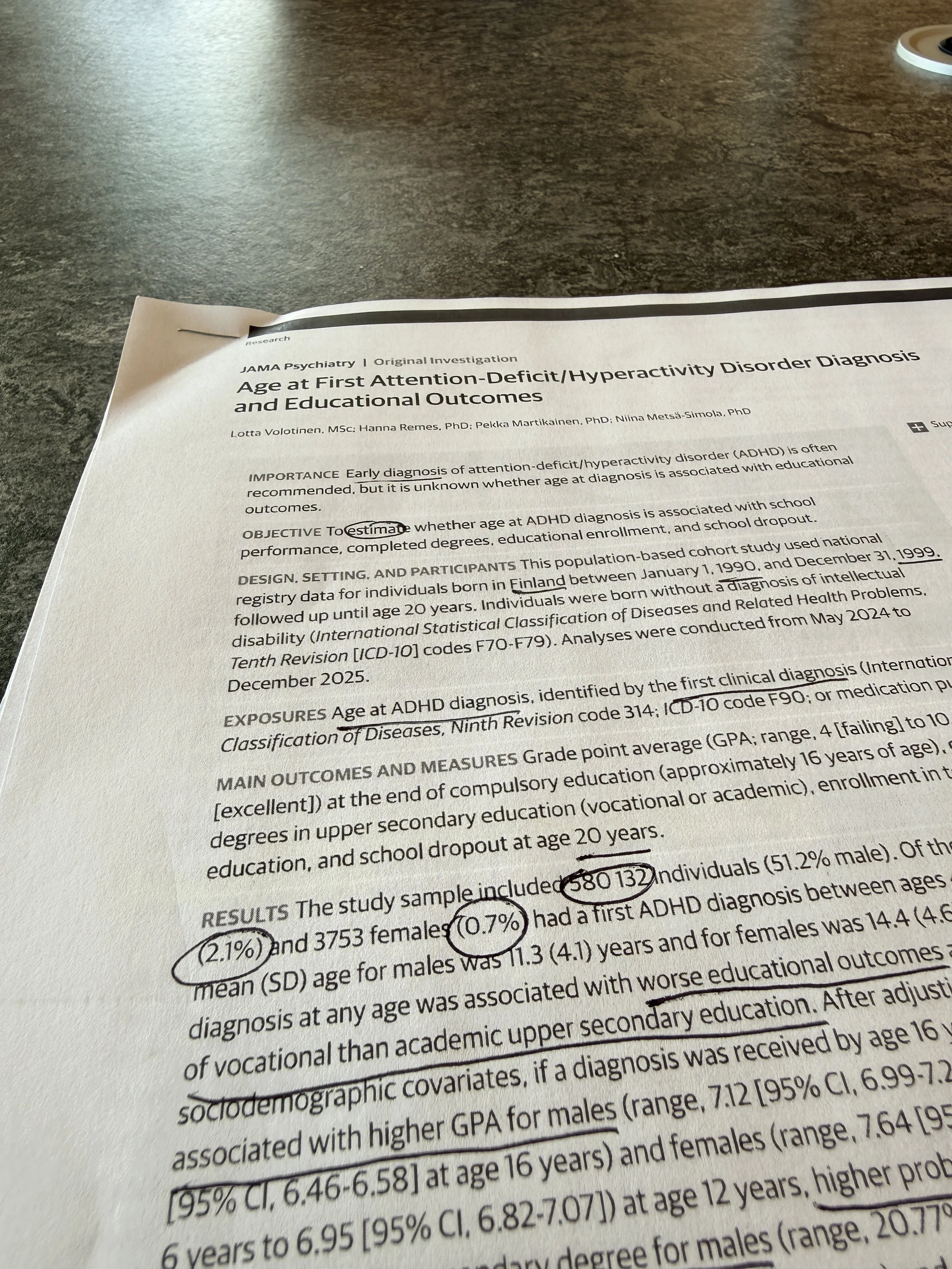
Study looked at 580,132 individuals born 1990-1999 in Finland, from birth to 20 years old.
Of the study population, only 2.1% males were diagnosed with ADHD and only 0.7% females were diagnosed with ADHD (this is lower than I would expect given usual statistics of 7-8% of general population have ADHD).
Females were diagnosed later than males. This is expected and well established in literature due to more inattentive symptoms in females.
Males were more likely to be diagnosed in the first couple years of school (peak around 8 years old, mean around 4 years old). Females were more likely to be diagnosed later (peak incidence between 14-20 years old, mean around 14 years old). Remember that study ended at 20 years old, so it could be even later!
Those diagnosed with ADHD had a lower GPA than those that were not diagnosed with ADHD (both males and females).
Within those that were diagnosed with ADHD, getting a diagnosis later was also associated with lower GPA than those that got diagnosed earlier.
At age 20, those diagnosed with ADHD were more likely to have a degree from a trade school than from academic college/university. Older age at diagnosis of ADHD was also associated with decreased probability of academic college/university.
Older age at diagnosis of ADHD was associated with increased probability of school dropout among both males and females.

“ADHD diagnosis during the first years of school was associated with better school performance, more academic track choices, and lower probability of school dropout.”
Key takeaways:
Individuals with ADHD diagnosis had worse academic outcomes
Academic outcomes differed by age at diagnosis
Those diagnosed with ADHD earlier in childhood had better academic performance (higher GPA, were more likely to advance to higher education, and less likely to drop out)
Those diagnosed with ADHD later in childhood had worse academic performance (lower GPA, less likely to advance to higher education, and were more likely to drop out of school)
The worst education outcomes were seen in those diagnosed with ADHD toward the end of their education
Males were diagnosed with ADHD most often during the first few years of school and females were more often diagnosed in adolescence after 13 years old.
This is the first study to report on the associations of age at ADHD diagnosis and educational outcomes.
Citation
Volotinen L, Remes H, Martikainen P, Metsä-Simola N. Age at First Attention-Deficit/Hyperactivity Disorder Diagnosis and Educational Outcomes. JAMA Psychiatry. Published online April 08, 2026. doi:10.1001/jamapsychiatry.2026.0181