ADHD and Perimenopause: Why So Many Women Feel Like They’re “Losing It” in Their 40s
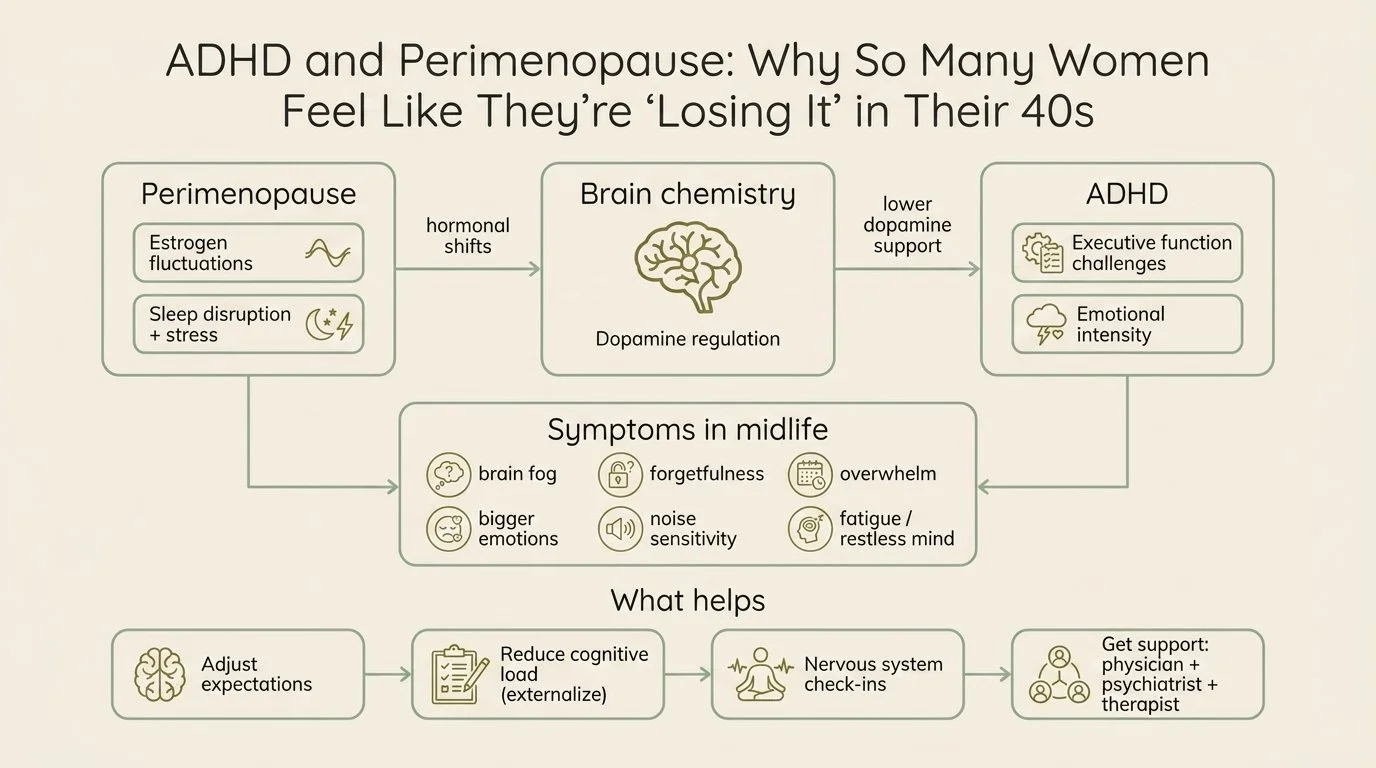
There’s a conversation happening quietly in therapy offices, women’s groups, and late-night Google searches everywhere.
“Why can’t I focus anymore?”
“Why am I so overwhelmed?”
“Why do I suddenly feel anxious, forgetful, emotional, and exhausted?”
For many women approaching 50, the answer may not be burnout alone. It may be the intersection of ADHD and perimenopause.
And this isn’t easy. You’re not alone in feeling this way.
The Hidden Collision: ADHD and Hormonal Change
Many women with ADHD were never diagnosed when they were younger. They learned to compensate. They became high achievers, caretakers, organizers, professionals, mothers, and partners who pushed through by relying on structure, perfectionism, anxiety, or sheer determination. Does this sound familiar?
Then perimenopause arrives. For some women, this can be as early as mid - 30’s and for many, for sure in their 40’s. Some women don’t notice a change at all!
Hormonal fluctuations, especially changes in estrogen, can directly impact dopamine regulation in the brain. Dopamine plays a major role in attention, motivation, memory, emotional regulation, and executive functioning. These are the exact areas where ADHD already creates challenges.
So what happens?
The coping tools that worked for years suddenly stop working.
Women often describe it like this:
“My brain feels foggy all the time.”
“I walk into rooms and forget why.”
“I can’t manage my emotions like I used to.”
“Everything feels louder and harder.”
“I’m exhausted but my brain won’t shut off.”
“I feel unlike myself.”
What can be especially painful is that many women blame themselves first.
They assume they are failing, lazy, weak, aging poorly, or “too emotional.”
But often, this is neurological and hormonal, not a character flaw.
Why It Can Feel So Overwhelming
ADHD affects more than attention. It impacts executive functioning, which includes:
Organization
Time management
Emotional regulation
Task initiation
Prioritizing
Working memory
Mental flexibility
Perimenopause can intensify all of these.
At the same time, women in this season of life are often carrying enormous mental and emotional loads:
Aging parents
Career demands
Parenting teenagers or young adults
Relationship stress
Physical changes
Sleep disruption
Identity shifts
It becomes the perfect storm for overwhelm.
And because women are so used to functioning for everyone else, many suffer silently.
The Emotional Side No One Talks About Enough
One of the biggest concerns I hear from women is shame.
They say:
“I used to be so capable.”
“I feel scattered all the time.”
“I don’t recognize myself anymore.”
What can be helpful is understanding that ADHD in women often shows up internally, not always as hyperactivity, but as mental overload, emotional intensity, chronic self-criticism, and difficulty filtering stimulation.
Perimenopause can lower the brain’s tolerance for stress even further.
So suddenly:
Noise feels unbearable
Small tasks feel enormous
Emotional reactions feel bigger
Motivation disappears
Anxiety increases
Rest feels impossible
This can impact relationships, confidence, work performance, and self-esteem.
What Actually Helps
Let’s make this simple and doable.
You do not need to “power through” harder. In fact, that usually makes things worse.
Instead, this season often requires support, adaptation, and self-compassion.
1. Stop Measuring Yourself Against Your 30-Year-Old Brain
Your needs may be changing, and that’s okay.
Many women continue expecting themselves to function exactly the same while their bodies and brains are undergoing major shifts. Instead of judging yourself, begin asking:
What support do I need now?
What systems reduce overwhelm?
What actually restores me?
This is not giving up. This is adjusting intentionally.
2. Reduce Cognitive Load
Women with ADHD often carry invisible mental tabs all day long.
Externalizing information can help:
Use visual reminders
Keep routines simple
Write things down immediately
Create fewer decision points
Build transition time into your day
The goal is not perfection. The goal is reducing mental exhaustion.
3. Check in With Your Nervous System
Many women spend years disconnected from their bodies because they’ve had to keep moving.
Pause and ask:
Am I overstimulated?
Am I depleted?
Have I rested?
Have I eaten?
What emotion am I carrying right now?
Check in with your body and notice where you feel it?
Awareness creates choice.
4. Don’t Minimize Sleep, Stress, or Hormonal Support
Sleep disruption alone can dramatically worsen attention, memory, emotional regulation, and irritability.
If symptoms are significantly affecting daily functioning, it may be helpful to speak with:
A physician familiar with perimenopause
A psychiatrist knowledgeable about ADHD in women
A licensed therapist who understands hormonal transitions
You deserve support that looks at the full picture.
You Deserve Support
I think one of the most important messages women need to hear is this:
Your brain may be asking for a different kind of care now.
There is grief in realizing that the strategies that once worked no longer do. But there can also be freedom in learning to live more intentionally, more gently, and more honestly.
This season may invite you to stop surviving on adrenaline and start building sustainable support.
And that matters.
Because women spend so much of their lives caring for everyone else that they forget they are worthy of care, too.
This isn’t easy, and you’re not alone.